The latest Forum for the Journalism Innovation and Leadership (JI Leaders) programme at UCLan took place yesterday and delved into the thorny issue of how the news media considers the climate crisis.
Along with equipping reporters and editors for the challenging and urgent issues facing all of us, there’s also the same considerations all businesses face – how to exist as responsible, sustainable organisations.
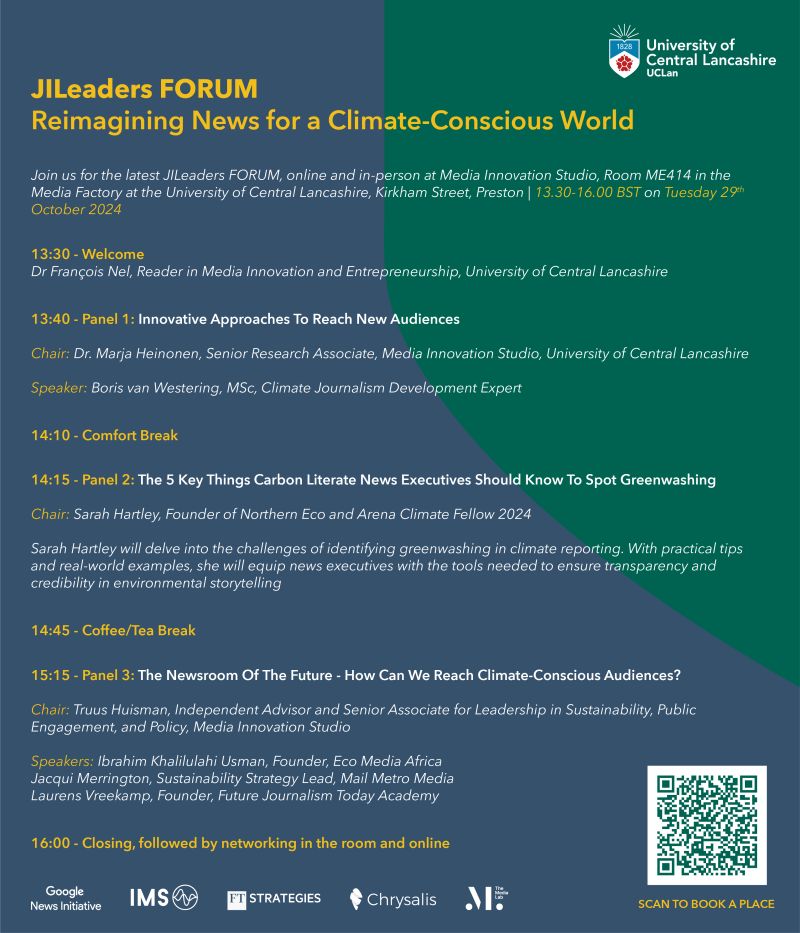
As you’ll see from the agenda below, the experts assembled to discuss these issues brought a great deal of experience to bear on the issue for participants who joined from the JI Leaders 2024 cohort in Preston and those simply interested in the topic who were able to join online.
What the agenda below doesn’t reveal was a surprise feature – three artists (Alex Gee, Geraldine Walkington and Paul Gedge ) also joined the afternoon’s discussion and gave their thoughts on what they heard through some hastily created drawings!

Bringing environmental journalism and art together! Sounds like my perfect gig.
My three takeaways from what was a thought-provoking afternoon:
- Ibrahim Khalilulahi Usman spoke with great clarity about the challenge he faces at his publication Eco Media Africa in covering the three critical issues for his audience; the climate crisis, air pollution and biodiversity. He concentrates on how best to spell out in a simple way those complex issues for a readership often unfamiliar with the terminologies and the science behind it.
- When it comes to AI (of course, it had to be mentioned!) it was great to hear from Laurens Vreecamp of The Future Journalism Today Academy about an initiative in the Netherlands which launched a local wilding project asking readers to give over a small patch of land. The response was so overwhelmingly successful that AI was needed to help sort the results.
- Bringing the art into storytelling in a major way has been part of Boris Van Westering‘s work. The delegates heard about this project which involved artists working alongside the Arab Reporters for Investigative Journalism (ARIJ). It’s a great example of a slower style of journalism which takes data at the source – in this case the migratory paths of falcons – and uses it to both investigate and explain with new storytelling forms.
For my part, I spoke about greenwashing and passed on five tips to help news executives spot the six different types of greenwashing.
- Looking at the words used in articles and advertising, getting to grips with their meanings
- Understanding ‘sexy numbers’ eg. what 1 tonne of CO2 looks like in everyday language
- How to find some expert help when it comes to science matters
- Taking climate to all ‘beats’ or editorial desks
- Equipping staff with the necessary training to properly understand the climate crisis
Thanks to the organisers for inviting me! I look forward to seeing what the latest cohort from this programme come up with in response.
 Dim Sum Digital